An Unreal Engine 5 EEG exploration project
Explore brain activity as an interactive experience.
UnrealEEG is being developed as an Unreal Engine foundation for researchers and developers building EEG experiments, tools, and interactive experiences. A free application will also give supported headset owners an accessible way to explore their own EEG.
How the project began
A chance to work together again led us to explore BCI.
UnrealEEG is being developed at Analogica by its founder Bob and long term friend and coworker Nikos, who together form the project’s two-person team. A collaboration that began whilst working on VR technologies and product development at Sony's London Studio. The result of a conversation that has continued long after leaving to pursue independent paths.
At London Studio, we contributed to wider SIE efforts exploring PlayStation 5 and PlayStation VR2. Our work focused particularly on controllers and hardware related to fully immersive UI and on creating prototypes to investigate how new hardware capabilities could shape the design and future of the user experience.
UnrealEEG began when Bob felt it was time for Analogica to refocus on some more experimental R&D work to balance its highly product-focused co-development work for AAA studios. We have always shared an interest in how people interact with technology and how new forms of input can shape new interactive paradigms. BCI whilst still in its infancy feels like a natural next step.
Coming from games and computer science rather than neuroscience, we started with a focus on the data. In particular, we focused on OpenMIIR, a public EEG research dataset. This gave us a practical way to learn about EEG signals, how they are structured and processed, and how that can be visualized inside an Unreal Engine runtime.
The result of that initial exploration is a recorded-data playback system and the foundation of a wider project that we think could be of interest both to game developers with an interest in exploring EEG as a potential input channel, as well as neuroscientists interested in harnessing the interaction and visualization potential offered by a UE host.
Current state and direction
Supported live acquisition and local recording through the same processing, visualization, and replay path
Unreal foundation for EEG research and development, demonstrated through a free application
Inside UnrealEEG
Processing, visualization, and interaction in one real-time application.
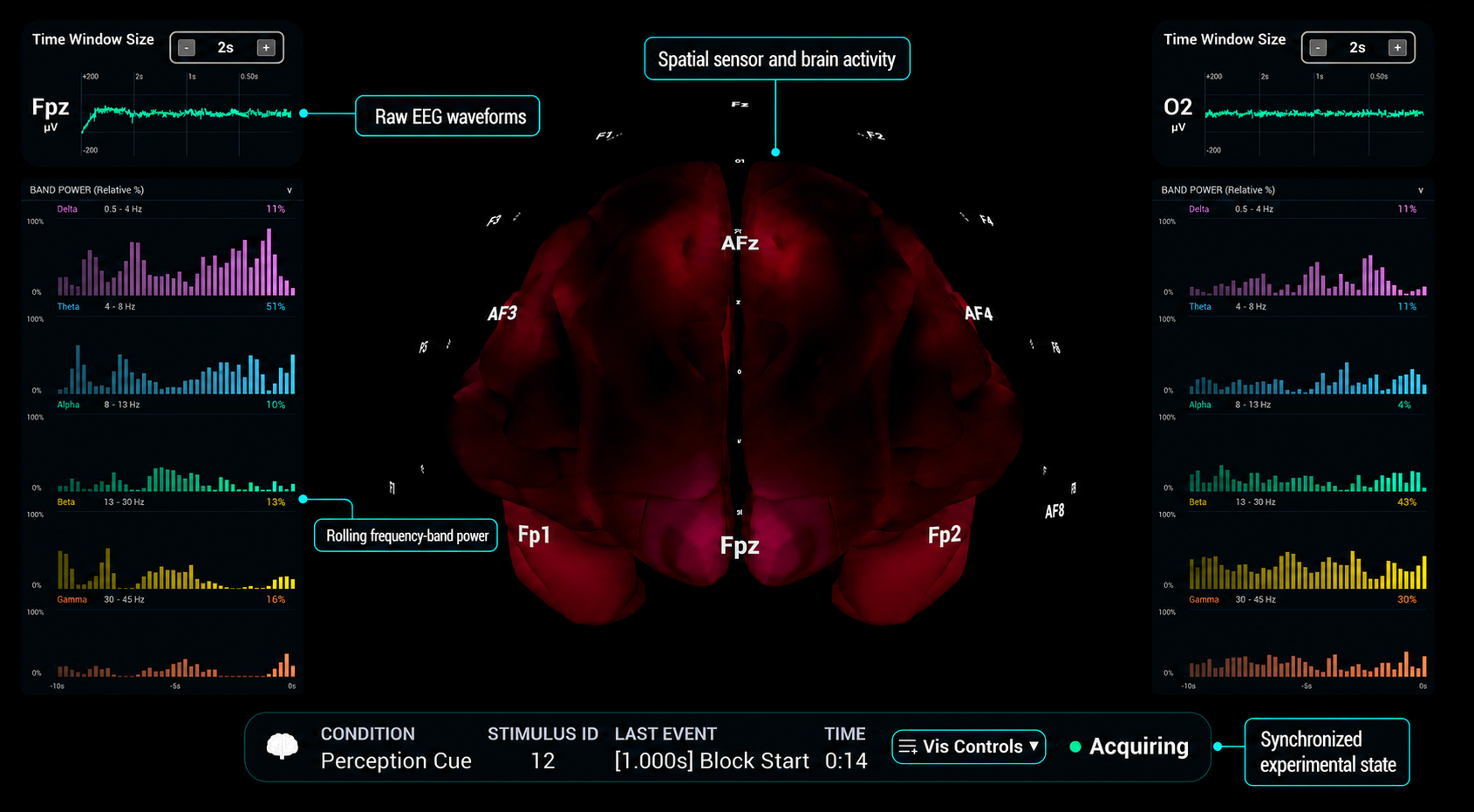
The current demo brings local signal processing, synchronized visualization, interaction, and replay together inside Unreal Engine. The values driving its displays can also become inputs to materials, lighting, sound, animation, UI, gameplay, or events. UnrealEEG does not claim to invent EEG-to-Unreal; its value is making more of the complete path coherent and approachable.
Demo today
Signal processing
Local runtime analysis
- Recorded raw EEG processed locally
- Native C++ windowed DSP
- Time-domain analysis
- Frequency-domain analysis
Visualization
Signals made spatial
- Spatial sensor activity in 3D
- Signal-driven colour, brightness, and scale
- Live-updating waveform graphs
- Rolling band-power histories
Interaction and replay
Explore, inspect, revisit
- Selectable sensors and detail panels
- Free-fly, orbit, and fixed cameras
- Synchronized cues and events
- Playback and visualization controls
Proposed development
Bring the existing foundation to supported live devices.
The proposed live system extends the beginning of the path. It does not replace the runtime processing, replay, features, and visuals already working in the demo. Connect supported devices, process incoming signals, record locally, and replay sessions through the same visual path.
How the path grows
Proposed next
EEG headsetContinuous raw signal
Acquire + normalizeChannels, units, timing
Record locally (optional)Keep sessions available for replay
Existing foundation
Process, derive, visualize, and replay
The working UnrealEEG core continues from here.
Live acquisition a new input source for the working system.
Supporting more than one headset is an important part of UnrealEEG’s direction. Within the available budget, we plan to build that support progressively, beginning with devices that help establish a reliable common input while testing meaningfully different capabilities and access models. Because devices vary in how they expose live raw data and in the software required to use it, each integration may take a different route before reaching the shared UnrealEEG foundation.
OpenBCI and Muse are examples of complementary hardware targets we would like to explore. OpenBCI’s open approach, range of devices, flexible sensor configurations, and active community make it valuable for testing UnrealEEG across different setups. Muse represents a different kind of target: an approachable consumer headset with a small sensor set and a history of research use. It could provide a practical baseline for understanding what the application can offer with minimal hardware before moving toward richer configurations.
Extend the foundation in meaningful ways.
Live acquisition is the enabling step. From there, the work would focus on three practical areas.
Proposed directions
Extract useful EEG features
The existing frequency-band and signal analysis provides the base for a broader processing toolkit. This would include configurable filters, signal-quality checks, and calibration for each user and session. Analysis could also be linked to timed cues inside Unreal. This could support experiments with changing brain rhythms, responses to stimuli, imagined movement, and other established EEG patterns. The raw signal and every processing stage would remain accessible.
Turn EEG into Unreal input
The positioned sensors in the current visualization already change colour, brightness, and scale in response to signal intensity and dominant frequency bands. Configurable mappings would open those connections to C++ and Blueprints. Developers could choose which sensors and features to use, then adjust how the values respond. They could also decide when a changing value should trigger an event. The results could then drive materials, lighting, sound, animation, UI, or gameplay.
Build richer 3D EEG views
The positioned sensors and brain model provide the starting point for a richer spatial view. Different sensor displays and smoother activity maps based on the positioned scalp sensors could make the signal easier to explore. Colour, light, scale, and materials could offer greater control over how the data is presented. Users could focus on selected sensors or isolate parts of the model. They could also compare different features and moments, with additional graphs available for closer analysis.
One foundation, two communities
Bringing researchers into Unreal, and Unreal developers into BCI.
Intended outcome
For researchers
Build experiments in Unreal without starting from scratch.
UnrealEEG gives researchers a practical starting point for creating EEG experiments and interactive research tools in Unreal, so they can focus on the question, experience, and feedback rather than assembling the complete technical pipeline first.
For Unreal developers
Work with EEG without first becoming a signal-processing specialist.
UnrealEEG makes processed EEG available as a source of input that developers can understand, inspect, and connect to the Unreal systems they already work with, opening a more approachable route into BCI experimentation.
The people behind UnrealEEG
Analogica is a UK-based two-person studio.
Bob and Nikos met at Sony London Studio while exploring how prospective PlayStation hardware and input features might support new forms of gameplay. UnrealEEG continues that shared interest in unfamiliar input technology.
Project direction and technical perspective
Bob Dowland
Bob Dowland is the founder of Analogica and a specialist in real-time animation, physics, and simulation. His career spans games, VR, robotics, human factors, and scientific visualization. At NaturalMotion, he was one of the founding engineers behind Euphoria Network and helped develop and integrate Euphoria and Morpheme technology for AAA studios including Rockstar and LucasArts. At Sony London Studio, he conceived and developed systems for real-time interaction between animated hands and physically simulated VR environments. On UnrealEEG, he provides project direction and brings a long-standing focus on turning experimental ideas into usable interactive systems.
Implementation and technical development
Nikos Asfis
Nikos Asfis is a multidisciplinary game developer who combines extensive programming experience with hands-on involvement in game design and wider development. As Lead Programmer at Roll7, he led development on OlliOlli and OlliOlli2; the original won the 2015 BAFTA for Sport. At Sony London Studio, he worked on PlayStation VR Worlds and Blood & Truth, as well as prototypes exploring prospective PlayStation hardware and input features. He later co-founded Pixel Magnet, taking on responsibilities across multiple areas of development for the VR title Masternoid. On UnrealEEG, he brings the same breadth to Unreal C++, signal processing, visualization, UI, and application development.
Explore UnrealEEG
The demo is working. The larger idea is still worth exploring.
UnrealEEG is self-directed R&D developed by Analogica. The next milestone is to add supported live acquisition and develop the existing foundation into a free application and reusable Unreal project.